Send the form and the duct cleaning stops sitting on your list.
You're asking because something made you wonder. Maybe it's dust settling again an hour after you clean, or the vents look dark when you pull the cover off, or someone in the house has been stuffed up since the furnace kicked on. Whatever it was, you want a straight answer, not a sales pitch.
Oil heat runs hard here from October through April, and that system pushes air through the same ducts for months without a break. Summers get muggy enough that the AC is doing the same job in reverse. Air moving through ductwork that's never been cleaned carries whatever's built up in there, and in a house that heats with oil, that can mean more than the usual dust.
Whether cleaning is worth it for your house depends on things only someone standing in your basement can see. How the ducts were run, what's collected in them, whether the returns are drawing dust from somewhere you can't see. That's not a guess anyone should make from a search page.
What you can do here is skip the part where you call around Rockingham County trying to find someone who'll actually show up and look. Send the request and it goes to a local contractor who cleans ducts in this area as a regular part of the work, someone who knows what oil heat leaves behind in a duct system and what a Portsmouth basement usually looks like before they ever open your vents. You're not getting a list of five companies to sort through. It's one call, from someone who already knows the kind of system you're asking about.
From there it's off your plate. No more searching, no more wondering who's reputable. Just an answer about your own ducts, from someone qualified to give it.
For most houses in Portsmouth, duct cleaning isn't worth doing on a schedule, but it is worth doing when something is actually wrong. Most homes here heat with oil, and oil heat leaves soot. If your ducts look dark at the register or dust seems to resettle within an hour of cleaning, that's buildup worth removing, not something a filter change will fix. If nothing looks or smells off, cleaning the ducts themselves won't make your air noticeably cleaner or your furnace run cheaper. What matters more here is what's attached to the ducts: a furnace that hasn't been serviced, a filter that's overdue, or a return that's never been checked for leaks. A contractor who works on oil systems in this area can tell you in one visit whether your ducts need cleaning or whether the real problem is upstream of them.
Before you get your ductwork cleaningAfter you get your ductwork cleaning
A crew doesn't just stick a vacuum in one vent and call it done. The whole system gets put under negative pressure first, either from a truck outside or a portable unit hooked to the main trunk, so loosened soot has somewhere to go instead of settling back down a few feet away. From there someone works a brush through each branch line, knocking soot off the walls of the duct before it gets pulled out. Registers and return grilles come off and get cleaned on their own, since they catch as much soot as the ducts do, sometimes more. On an oil system, the furnace's heat exchanger and blower wheel usually get wiped down too, because that's where a lot of the soot starts before it ever reaches the ductwork. Supply and return get treated as separate jobs, since soot doesn't build up the same way on each side. A camera run through the trunk before and after is how you know the soot actually left the house instead of just moving from one duct to the next.
How a duct cleaning actually goes
A duct cleaning crew runs a brush or whip through each branch line to knock soot and dust loose before vacuuming it out.
The whole system gets pulled under negative pressure from a vacuum truck or a portable unit hooked to the main trunk line.
Every register and return grille gets pulled off and cleaned separately, since they trap as much soot as the ducts themselves.
A oil-fired furnace's heat exchanger and blower wheel often get wiped down in the same visit, since soot collects there too.
The supply side and the return side get cleaned as two separate passes, because soot builds up differently on each.
A camera run through the main trunk before and after shows whether the soot actually came out or just moved around.
One request and it's handed off
Your duct cleaning request goes to one local pro.
Send the request and finding a pro stops being your problem.
How does the duct cleaning crew know they got everything out?
You've seen the before and after shots and read how the brush and vacuum work, but you're wondering what actually tells the crew they're done. It's a fair question. Nobody wants to pay for a cleaning and find out later that half the soot is still sitting in the trunk line because the crew called it good too early.
A tech checks each vent with a camera or a mirror after it's cleaned
A tech runs a camera down a few branch lines, or at least looks into each register with a flashlight and mirror, to check the metal is bare. With oil heat, that means no soot film on the inside walls of the duct, not just the grille looking clean. The return side gets the same check, since that's where the dust gets pulled back in on the next cycle. If a line still shows buildup, it gets another pass with the brush or whip before the vacuum runs again. A crew that skips this step and just pulls the hose and leaves hasn't finished the job, whatever the vents look like from the room.
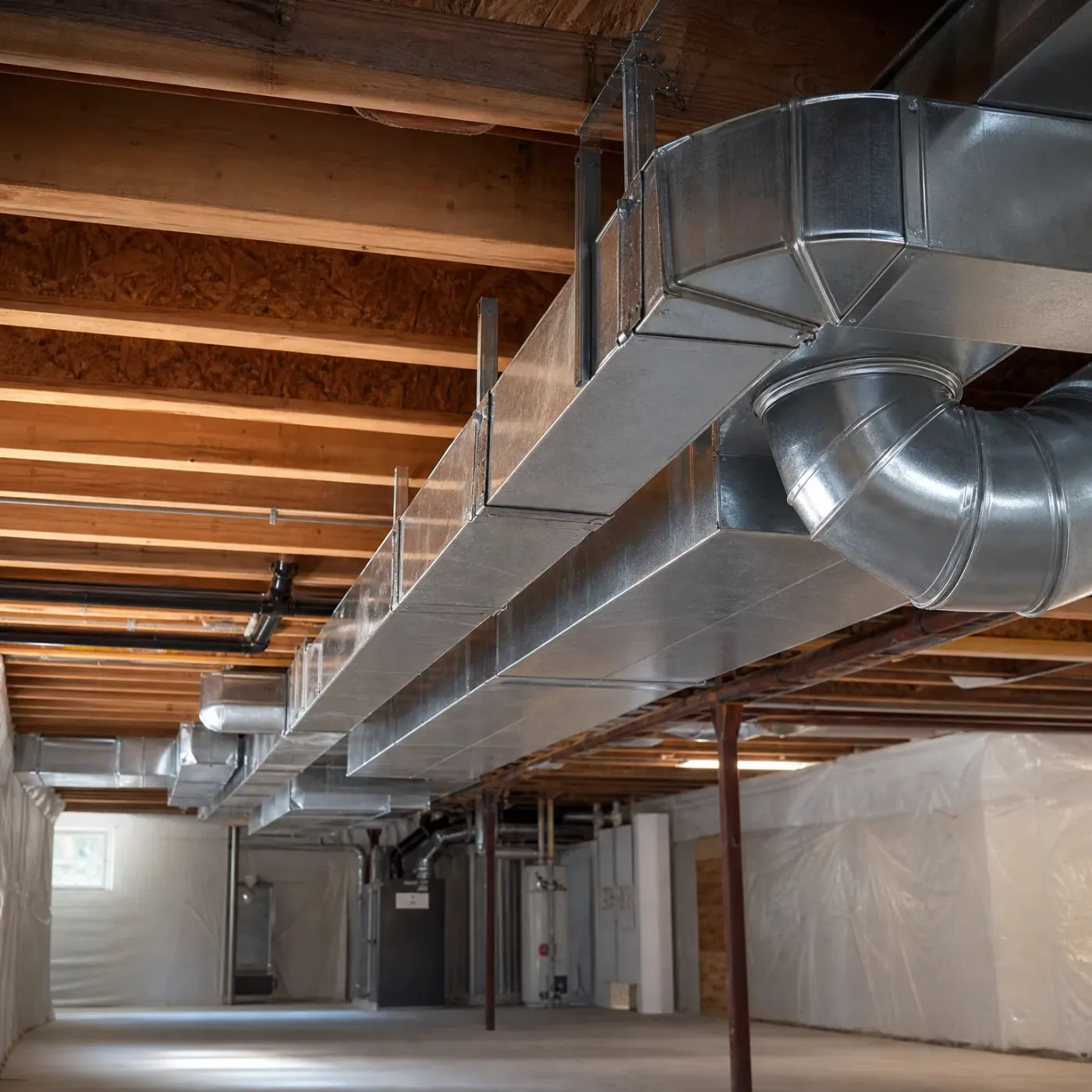
Ducts like this move air the way they should, with no soot ring at the register and nothing settling back on the furniture.
Water staining on the foundation wall means moisture is getting into that joist bay, and damp ducts can start growing something you don't want blown through the house.
Power here costs 24.24 cents per kilowatt-hour
At 24.24 cents per kilowatt-hour, running a vacuum unit or air handler longer than it needs to shows up on your bill fast. A clogged, sooty duct run makes the blower work harder to push the same air through your house, and that strain is what you're paying for.
EIA-861 2025
Why oil heat is the real culprit
Oil furnaces burn dirtier than gas ones, and that soot has to go somewhere. Some of it clings to the heat exchanger and flue, but a share of it rides the airflow into your ductwork and settles along the branch lines. Over a winter of running the furnace most days, that buildup thickens. It's why oil-heated homes in Portsmouth tend to show dark rings at the registers that gas-heated homes rarely get. The fuel you burn has more to do with what's in your ducts than the age of the house or how often you vacuum.
What a dirty duct does to airflow
A duct caked with soot and dust has a narrower path for air to move through, the same way a clogged pipe slows water. Your blower has to push harder to deliver the same amount of air to each room, and rooms at the end of a long run often end up with weaker airflow than the ones close to the furnace. That strain doesn't show up as a single event. It shows up as a system working harder, month after month, to do what it used to do without effort.
What does a house in Rockingham County tell you about your ducts?
Half the homes here were built by 1983
Half the homes in Rockingham County were built in 1983 or earlier, half in 1983 or later. Older ductwork has had more years to collect soot and more joints where it can leak.
Heat runs October through May
Heat runs about eight months a year here, October through May. That's eight months of oil soot moving through your ducts every year you own the house.
Cooling runs July through August
Cooling only runs about two months, July and August. The rest of the year, those same ducts are carrying heated air, so oil residue is the bigger concern here, not summer dust.
ACS 2020-2024 · NOAA nClimDiv 1991-2020
Where That Leaves You
Duct cleaning in Portsmouth is worth it when soot, dark vents or resettling dust point to an actual problem, not on a fixed schedule.
Oil heat is the main reason ducts here collect soot faster than in homes heated with gas.
A crew that checks their own work with a camera or a visual pass after vacuuming gives you a way to confirm the job was done right.
Matching you with one licensed local contractor who works on oil-heated duct systems all winter means no round of competing calls to sort through.
Someone who services this kind of ductwork regularly already knows where soot tends to build up and where joints tend to leak.
Rockingham County's mix of older and newer ductwork means what your system needs depends on your house, not a general rule.
So the answer is simple. Duct cleaning is worth it in Portsmouth when there's a reason behind it, not because a calendar says it's time. Soot from oil heat is the thing to watch for, since it builds up along branch lines faster than it would in a gas-heated house. If you've seen dark rings at the register or dust that keeps coming back, that's your sign. If you haven't, there's no reason to pay for the work yet.
Once you decide to move on it, who does the cleaning matters as much as whether you do it. A crew that checks its own work afterward, with a camera or at least a visual pass through the ductwork, gives you something to point to besides their word. That matters more in a county like this one, where some ductwork is decades old and some is newer, and what your system needs isn't the same as what your neighbor's does.
You'll be matched with one licensed contractor local to the area, not a handful competing for your business. Someone who works on oil-heated systems all winter has already seen where the soot settles and where the joints tend to give out, in houses built the same years as yours. That's the kind of knowledge that doesn't come from a general checklist. It comes from doing the work on this equipment, in this county, season after season.